<?xml version="1.0" encoding="UTF-8"?>
<feed xmlns="http://www.w3.org/2005/Atom" xml:lang="en-gb">
	<link rel="self" type="application/atom+xml" href="https://forum.stereopi.com/app.php/feed/forum/15" />

	<title>StereoPi Forum</title>
	<subtitle>StereoPi Forum</subtitle>
	<link href="https://forum.stereopi.com/index.php" />
	<updated>2021-01-20T14:12:33+00:00</updated>

	<author><name><![CDATA[StereoPi Forum]]></name></author>
	<id>https://forum.stereopi.com/app.php/feed/forum/15</id>

		<entry>
		<author><name><![CDATA[stereomaton]]></name></author>
		<updated>2021-01-20T14:12:33+00:00</updated>

		<published>2021-01-20T14:12:33+00:00</published>
		<id>https://forum.stereopi.com/viewtopic.php?p=2399#p2399</id>
		<link href="https://forum.stereopi.com/viewtopic.php?p=2399#p2399"/>
		<title type="html"><![CDATA[The art of stereoscopic photo • Re: viewing stereo images on the web site]]></title>

					<category term="The art of stereoscopic photo" scheme="https://forum.stereopi.com/viewforum.php?f=15" label="The art of stereoscopic photo"/>
		
		<content type="html" xml:base="https://forum.stereopi.com/viewtopic.php?p=2399#p2399"><![CDATA[
<blockquote class="uncited"><div>It would be nice if the web site had some sort of live javascript that allowed left and right images to be swapped in-situ by the reader, to allow either type of viewing</div></blockquote>A popular viewer is "HTML5 Stereo Viewer" from Masuji SUTO. As far as I understood, it is only distributed with StereoPhotoMaker (<a href="http://www.stereo.jpn.org/eng/stphmkr/index.html" class="postlink">http://www.stereo.jpn.org/eng/stphmkr/index.html</a>) but can be extracted and modified for your own use afterwards. It can be used for offline web sites too.<br><br>There is also the embedded viewer of Stereopix, but it is only for online sites. It also allows visualization in Oculus devices (and other devices that support WebXR): <a href="https://stereopix.net/photolab/help/embed" class="postlink">https://stereopix.net/photolab/help/embed</a><br><br>Both have more modes than only parallel and cross views.<p>Statistics: Posted by <a href="https://forum.stereopi.com/memberlist.php?mode=viewprofile&amp;u=101">stereomaton</a> — Wed Jan 20, 2021 2:12 pm</p><hr />
]]></content>
	</entry>
		<entry>
		<author><name><![CDATA[stereomaton]]></name></author>
		<updated>2020-05-20T17:06:12+00:00</updated>

		<published>2020-05-20T17:06:12+00:00</published>
		<id>https://forum.stereopi.com/viewtopic.php?p=1987#p1987</id>
		<link href="https://forum.stereopi.com/viewtopic.php?p=1987#p1987"/>
		<title type="html"><![CDATA[The art of stereoscopic photo • Re: Low Profile (staggered) Stereovision?]]></title>

					<category term="The art of stereoscopic photo" scheme="https://forum.stereopi.com/viewforum.php?f=15" label="The art of stereoscopic photo"/>
		
		<content type="html" xml:base="https://forum.stereopi.com/viewtopic.php?p=1987#p1987"><![CDATA[
I thought of this geometric problem again, and I came to something that I knew but missed in my previous answers.<br><br>Actually, you can totally align the images produced by the "staggered disposition", but the result will probably not be what you want. After alignment, the disparity will denote depth in a direction perpendicular to the line between the cameras, thus not in front of your plane. Also, because the field of view will be on the side of the equivalent stereo system, the model might be more sensible to bad calibration.<p>Statistics: Posted by <a href="https://forum.stereopi.com/memberlist.php?mode=viewprofile&amp;u=101">stereomaton</a> — Wed May 20, 2020 5:06 pm</p><hr />
]]></content>
	</entry>
		<entry>
		<author><name><![CDATA[stereomaton]]></name></author>
		<updated>2020-04-05T12:32:06+00:00</updated>

		<published>2020-04-05T12:32:06+00:00</published>
		<id>https://forum.stereopi.com/viewtopic.php?p=1832#p1832</id>
		<link href="https://forum.stereopi.com/viewtopic.php?p=1832#p1832"/>
		<title type="html"><![CDATA[The art of stereoscopic photo • Re: Low Profile (staggered) Stereovision?]]></title>

					<category term="The art of stereoscopic photo" scheme="https://forum.stereopi.com/viewforum.php?f=15" label="The art of stereoscopic photo"/>
		
		<content type="html" xml:base="https://forum.stereopi.com/viewtopic.php?p=1832#p1832"><![CDATA[
It depends on the application (some are not real time), but you did not give context.<br>By the way, the disparity is linked to the base size, but also to the focal length (longer focal = narrower field of view = biggest disparity for the same z)<p>Statistics: Posted by <a href="https://forum.stereopi.com/memberlist.php?mode=viewprofile&amp;u=101">stereomaton</a> — Sun Apr 05, 2020 12:32 pm</p><hr />
]]></content>
	</entry>
		<entry>
		<author><name><![CDATA[78163]]></name></author>
		<updated>2020-03-30T14:06:48+00:00</updated>

		<published>2020-03-30T14:06:48+00:00</published>
		<id>https://forum.stereopi.com/viewtopic.php?p=1820#p1820</id>
		<link href="https://forum.stereopi.com/viewtopic.php?p=1820#p1820"/>
		<title type="html"><![CDATA[The art of stereoscopic photo • Re: Low Profile (staggered) Stereovision?]]></title>

					<category term="The art of stereoscopic photo" scheme="https://forum.stereopi.com/viewforum.php?f=15" label="The art of stereoscopic photo"/>
		
		<content type="html" xml:base="https://forum.stereopi.com/viewtopic.php?p=1820#p1820"><![CDATA[
<blockquote class="uncited"><div>Sure. As I said, it is not in the context of real time depth extraction (it took several tens of seconds on a 4GHz processor, monothread).<br>I only pointed out that, although the signal is small, it is present in the image.</div></blockquote>That definitely is a hurdle!<p>Statistics: Posted by <a href="https://forum.stereopi.com/memberlist.php?mode=viewprofile&amp;u=355">78163</a> — Mon Mar 30, 2020 2:06 pm</p><hr />
]]></content>
	</entry>
		<entry>
		<author><name><![CDATA[78163]]></name></author>
		<updated>2020-03-30T14:03:13+00:00</updated>

		<published>2020-03-30T14:03:13+00:00</published>
		<id>https://forum.stereopi.com/viewtopic.php?p=1819#p1819</id>
		<link href="https://forum.stereopi.com/viewtopic.php?p=1819#p1819"/>
		<title type="html"><![CDATA[The art of stereoscopic photo • Re: Low Profile (staggered) Stereovision?]]></title>

					<category term="The art of stereoscopic photo" scheme="https://forum.stereopi.com/viewforum.php?f=15" label="The art of stereoscopic photo"/>
		
		<content type="html" xml:base="https://forum.stereopi.com/viewtopic.php?p=1819#p1819"><![CDATA[
<div class="codebox"><p>Code: </p><pre><code>But I considered you'd use both images for a disparity map, where OpenCV try to find a horizontal difference between the similar fragments on the left and right image.</code></pre></div>I was at first.  But then started to realize that it would be blending two techniques at the same time, which certainly isn't supported by OpenCV.<br><blockquote class="uncited"><div>A have had an idea to use H264 encoder, as it compares 16x16 fragments between a sequence of images. You might know about motion vectors, calculated as a part of H264 encoding by Pi's hardware (here and here on YouTube). Unfortunately, it has some limitations and will not work for either depth map or optical flow. But the bonus is just a couple of percents of CPU load. May be I will come back to these experiments.</div></blockquote><blockquote class="uncited"><div>1280x720 is too high load for the Pi to get a real-time depth map. But in my experiment with "2D lidar-like mode" I used not all frame, but just a strip in the middle for the 640x480 image with ~30% height (instead of 320x240 for all frame). And got a good FPS. It means you can use a very small strip from 1280 image to get this.</div></blockquote>I think you are onto something here.  It's too bad the 16x16 chunking doesn't work natively with the depth map or optical flow.  But it gave me an idea with respect to the flight realm (this might be a different topic).  <br><br>A group is working on generating a real-time flight path vector from ardupilot (<a href="https://diydrones.com/profiles/blogs/airspeed-angle-of-attack-sideslip-and-flight-path-vector?id=705844%3ABlogPost%3A1641958&amp;page=3#comments" class="postlink">https://diydrones.com/profiles/blogs/ai ... 3#comments</a>).  <br><br>Since the flight path vector represents the future (linear*) flight path of the aircraft, we know where in the FPV image is the most important place to look.  Additionally, we know the aircraft velocity and responsiveness.<br><br>*not perfectly linear, but safe to approximate as such<br><br>Cropping the image around the flight path vector with the crop mask coupled to aircraft velocity and responsiveness, we can basically remove all of the extraneous background noise for "non-threat" obstacles.  As the aircraft velocity increases, the cropped image is smaller and tighter around the flight path vector.  As the velocity decreases, the cropped image increases in size until it is 100% of the original image.  <br><br><img src="https://res.cloudinary.com/dsu/image/upload/v1585576417/velocvect_ynhzx6.png" class="postimage" alt="Image"><br><br>Biologically we do the same thing when riding a bike...low speed focus a meter in front, high speed focus out on the horizon.  <br><br>Computationally this might be too expensive for just one pi, but if you 'stream' the images from one single board computer to another, there might be a slight advantage.  When slowing back down, you might run into problems since the small images won't compare to the large images.<br><br>I'm sure this has been implemented elsewhere since it is pretty intuitive, but your mention of the H264 encoder made me think, why not target the most important part of the image and dump the rest since processing power is the limiting factor.<p>Statistics: Posted by <a href="https://forum.stereopi.com/memberlist.php?mode=viewprofile&amp;u=355">78163</a> — Mon Mar 30, 2020 2:03 pm</p><hr />
]]></content>
	</entry>
		<entry>
		<author><name><![CDATA[stereomaton]]></name></author>
		<updated>2020-03-30T12:21:59+00:00</updated>

		<published>2020-03-30T12:21:59+00:00</published>
		<id>https://forum.stereopi.com/viewtopic.php?p=1815#p1815</id>
		<link href="https://forum.stereopi.com/viewtopic.php?p=1815#p1815"/>
		<title type="html"><![CDATA[The art of stereoscopic photo • Re: Low Profile (staggered) Stereovision?]]></title>

					<category term="The art of stereoscopic photo" scheme="https://forum.stereopi.com/viewforum.php?f=15" label="The art of stereoscopic photo"/>
		
		<content type="html" xml:base="https://forum.stereopi.com/viewtopic.php?p=1815#p1815"><![CDATA[
Sure. As I said, it is not in the context of real time depth extraction (it took several tens of seconds on a 4GHz processor, monothread).<br>I only pointed out that, although the signal is small, it is present in the image.<br>The signal is smaller and smaller when your subject is placed farther away.<br>Of course, it is harder to extract when it's subtle.<p>Statistics: Posted by <a href="https://forum.stereopi.com/memberlist.php?mode=viewprofile&amp;u=101">stereomaton</a> — Mon Mar 30, 2020 12:21 pm</p><hr />
]]></content>
	</entry>
		<entry>
		<author><name><![CDATA[Realizator]]></name></author>
		<updated>2020-03-29T13:38:02+00:00</updated>

		<published>2020-03-29T13:38:02+00:00</published>
		<id>https://forum.stereopi.com/viewtopic.php?p=1808#p1808</id>
		<link href="https://forum.stereopi.com/viewtopic.php?p=1808#p1808"/>
		<title type="html"><![CDATA[The art of stereoscopic photo • Re: Low Profile (staggered) Stereovision?]]></title>

					<category term="The art of stereoscopic photo" scheme="https://forum.stereopi.com/viewforum.php?f=15" label="The art of stereoscopic photo"/>
		
		<content type="html" xml:base="https://forum.stereopi.com/viewtopic.php?p=1808#p1808"><![CDATA[
<blockquote class="uncited"><div>As you can see in the next image, even with a such small base on 720p image, you could retrieve quite a lot of good quality depth information. Here, it was extracted with a (slow) dense optical flow estimator, whose result was projected into horizontal direction (ie. ignoring vertical displacement). Estimated disparity was between -2.09 and 4.64 pixels. You could perhaps not extract that amount of details in realtime easily, but the information is truly there.</div></blockquote>1280x720 is too high load for the Pi to get a real-time depth map. But in my experiment with "2D lidar-like mode" I used not all frame, but just a strip in the middle for the 640x480 image with ~30% height (instead of 320x240 for all frame). And got a good FPS. It means you can use a very small strip from 1280 image to get this. The bottleneck here is an image undistortion - we need to undistort the whole "big" frame to cut a small strip later, and this is a computationally heavy operation.<br>Now we're going to the scope of extreme solution optimization to get the maximum performance from our hardware. It's challenging and very interesting! We've not yet touched our GPU power and OpenGL - it might be helpful for undistortion on-the-go. Custom shaders and all that staff is a challenge too...<p>Statistics: Posted by <a href="https://forum.stereopi.com/memberlist.php?mode=viewprofile&amp;u=2">Realizator</a> — Sun Mar 29, 2020 1:38 pm</p><hr />
]]></content>
	</entry>
		<entry>
		<author><name><![CDATA[Realizator]]></name></author>
		<updated>2020-03-29T13:14:33+00:00</updated>

		<published>2020-03-29T13:14:33+00:00</published>
		<id>https://forum.stereopi.com/viewtopic.php?p=1804#p1804</id>
		<link href="https://forum.stereopi.com/viewtopic.php?p=1804#p1804"/>
		<title type="html"><![CDATA[The art of stereoscopic photo • Re: Low Profile (staggered) Stereovision?]]></title>

					<category term="The art of stereoscopic photo" scheme="https://forum.stereopi.com/viewforum.php?f=15" label="The art of stereoscopic photo"/>
		
		<content type="html" xml:base="https://forum.stereopi.com/viewtopic.php?p=1804#p1804"><![CDATA[
<blockquote class="uncited"><div><blockquote class="uncited"><div>The first idea is that after scaling one of your images you'll actually get the same equivalent stereobase. You can not cheat a physics here.</div></blockquote>That's what is really bugging my brain.  Long story short, in flight school we're taught about visual illusions and how to mentally extract 3d information from monocular cues (night vision, etc.).  One of the most important is Retinal Image Size -&gt; "Increasing and Decreasing Size of Objects".  Here is the flight publication that teaches these cues: <a href="https://www.yumpu.com/en/document/read/7091224/tc-1-204-night-flight-techniques-and-procedures" class="postlink">https://www.yumpu.com/en/document/read/ ... procedures</a>.  They are on pages 1-14 to 1-16. Basically in flight, objects that grow in size are closer than objects that stay the same size.  <br><br>So, here's my cognitive problem.  Placing one camera in front of the other seems like you are scaling up the image from just one camera, in my mind I don't think all objects in the scene would scale uniformly.  For instance, scaling a picture makes the mountains larger too, which would not realistically be the case with one camera slightly closer to the mountains.  That's why I'm viewing it more from an optical flow perspective almost. <br>x78163</div></blockquote>Ah, now I got your idea. Actually, if we zoom both images to the "same" size, they will be a bit different, as they see a bit different perspective, as originally the same object for both cameras has a different solid angel (named Omega as a rule). But I considered you'd use both images for a disparity map, where OpenCV try to find a horizontal difference between the similar fragments on the left and right image. <br>In your case, as I understand, you use either biological neural network (I mean your brain), or optical-flow like computational approach. This is another approach.<br>I'd like to say, that StereoBM function (for computing disparity) is the only real-time algo in OpenCV for the depth map without hardware acceleration. But optical flow is more costly procedure. A have had an idea to use H264 encoder, as it compares 16x16 fragments between a sequence of images. You might know about motion vectors, calculated as a part of H264 encoding by Pi's hardware (<a href="https://www.youtube.com/watch?v=5Yw94-f3GnY" class="postlink">here</a> and <a href="https://www.youtube.com/watch?v=IjHmZZMT9O4" class="postlink">here</a> on YouTube). Unfortunately, it has some limitations and will not work for either depth map or optical flow. But the bonus is just a couple of percents of CPU load. May be I will come back to these experiments.<p>Statistics: Posted by <a href="https://forum.stereopi.com/memberlist.php?mode=viewprofile&amp;u=2">Realizator</a> — Sun Mar 29, 2020 1:14 pm</p><hr />
]]></content>
	</entry>
		<entry>
		<author><name><![CDATA[78163]]></name></author>
		<updated>2020-03-28T17:57:01+00:00</updated>

		<published>2020-03-28T17:57:01+00:00</published>
		<id>https://forum.stereopi.com/viewtopic.php?p=1803#p1803</id>
		<link href="https://forum.stereopi.com/viewtopic.php?p=1803#p1803"/>
		<title type="html"><![CDATA[The art of stereoscopic photo • Re: Low Profile (staggered) Stereovision?]]></title>

					<category term="The art of stereoscopic photo" scheme="https://forum.stereopi.com/viewforum.php?f=15" label="The art of stereoscopic photo"/>
		
		<content type="html" xml:base="https://forum.stereopi.com/viewtopic.php?p=1803#p1803"><![CDATA[
Gents,<br><br>Interesting.  I'm particularly intrigued by the wide angle lens concept.  That really is an interesting concept that I'm mentally face-palming myself about.  Though I don't think I'll pursue it as it seems the benefit is not worth the effort based on the performance feedback.  <br><br>Seeing the demo with the red camera convinced me that the stereobase width is not as big of a deal as I thought.  I can definitely proceed with my project without having to re-code the universe  <img class="smilies" src="https://forum.stereopi.com/images/smilies/icon_lol.gif" width="15" height="17" alt=":lol:" title="Laughing"> <br><br>However, I'm still trying to wrap my mind around some things.<br><blockquote class="uncited"><div>The first idea is that after scaling one of your images you'll actually get the same equivalent stereobase. You can not cheat a physics here.</div></blockquote>That's what is really bugging my brain.  Long story short, in flight school we're taught about visual illusions and how to mentally extract 3d information from monocular cues (night vision, etc.).  One of the most important is Retinal Image Size -&gt; "Increasing and Decreasing Size of Objects".  Here is the flight publication that teaches these cues: <a href="https://www.yumpu.com/en/document/read/7091224/tc-1-204-night-flight-techniques-and-procedures" class="postlink">https://www.yumpu.com/en/document/read/ ... procedures</a>.  They are on pages 1-14 to 1-16. Basically in flight, objects that grow in size are closer than objects that stay the same size.  <br><br>So, here's my cognitive problem.  Placing one camera in front of the other seems like you are scaling up the image from just one camera, in my mind I don't think all objects in the scene would scale uniformly.  For instance, scaling a picture makes the mountains larger too, which would not realistically be the case with one camera slightly closer to the mountains.  That's why I'm viewing it more from an optical flow perspective almost.  <br><blockquote class="uncited"><div>Furthermore, you would probably have some unwanted vertical parallax, both up and down (!), which is very hard to deal with.</div></blockquote>For sure!  That would be a pain to sort out.  Though once 'dealt with' it could actually provide some interesting navigation cues.<br><br>Thanks for the amazing feedback and your patience with my off the wall question!<br><br>v/r<br><br>x78163<p>Statistics: Posted by <a href="https://forum.stereopi.com/memberlist.php?mode=viewprofile&amp;u=355">78163</a> — Sat Mar 28, 2020 5:57 pm</p><hr />
]]></content>
	</entry>
		<entry>
		<author><name><![CDATA[stereomaton]]></name></author>
		<updated>2020-03-27T14:37:34+00:00</updated>

		<published>2020-03-27T14:37:34+00:00</published>
		<id>https://forum.stereopi.com/viewtopic.php?p=1798#p1798</id>
		<link href="https://forum.stereopi.com/viewtopic.php?p=1798#p1798"/>
		<title type="html"><![CDATA[The art of stereoscopic photo • Re: Low Profile (staggered) Stereovision?]]></title>

					<category term="The art of stereoscopic photo" scheme="https://forum.stereopi.com/viewforum.php?f=15" label="The art of stereoscopic photo"/>
		
		<content type="html" xml:base="https://forum.stereopi.com/viewtopic.php?p=1798#p1798"><![CDATA[
It's interesting, but I do not have time to think about this in details.<br>If you try it, let us know.<br><br>As Realizator, I doubt it would let you gain base size because you would have somehow to project one of your images into the reference of the second one. Furthermore, you would probably have some unwanted vertical parallax, both up and down (!), which is very hard to deal with.<br><br>On the other hand, I did a small experiment with small base system: In the commercial world, I know that the RED Hydrogen One has a very small base but creates photos that users like (well, this device sometimes "expand" artificially the depth depending on the scene to present it to the user). It has around 13mm base, but I do not know the equivalent focal length which also plays a role in depth scale.<br><br>I found a photo taken by the RH1 on the Internet and extracted the pair (reduced to 720p):<br><a href="https://ibb.co/tcKCfZT" class="postlink">https://ibb.co/tcKCfZT</a> &amp; <a href="https://ibb.co/Yp577HG" class="postlink">https://ibb.co/Yp577HG</a> (from <a href="https://www.dropbox.com/sh/fgu0ogu2a5i2eoq/AAA2QaidMlZfSrjrPPpn6gGEa?dl=0&amp;preview=bridge_h4v.jpg" class="postlink">https://www.dropbox.com/sh/fgu0ogu2a5i2 ... ge_h4v.jpg</a>)<br><br>As you can see in the next image, even with a such small base on 720p image, you could retrieve quite a lot of good quality depth information. Here, it was extracted with a (slow) dense optical flow estimator, whose result was projected into horizontal direction (ie. ignoring vertical displacement). Estimated disparity was between -2.09 and 4.64 pixels. You could perhaps not extract that amount of details in realtime easily, but the information is truly there.<br><br><img src="https://i.ibb.co/yphbCcH/bridge-mix.jpg" class="postimage" alt="Image"><br><br>This base is very small for the subject in question, because the depth of interest is very large.<br>Depending on the subject, as soon as you can get sub-pixel accuracy, you might get some results even with a small base.<p>Statistics: Posted by <a href="https://forum.stereopi.com/memberlist.php?mode=viewprofile&amp;u=101">stereomaton</a> — Fri Mar 27, 2020 2:37 pm</p><hr />
]]></content>
	</entry>
		<entry>
		<author><name><![CDATA[Realizator]]></name></author>
		<updated>2020-03-27T11:45:27+00:00</updated>

		<published>2020-03-27T11:45:27+00:00</published>
		<id>https://forum.stereopi.com/viewtopic.php?p=1797#p1797</id>
		<link href="https://forum.stereopi.com/viewtopic.php?p=1797#p1797"/>
		<title type="html"><![CDATA[The art of stereoscopic photo • Re: Low Profile (staggered) Stereovision?]]></title>

					<category term="The art of stereoscopic photo" scheme="https://forum.stereopi.com/viewforum.php?f=15" label="The art of stereoscopic photo"/>
		
		<content type="html" xml:base="https://forum.stereopi.com/viewtopic.php?p=1797#p1797"><![CDATA[
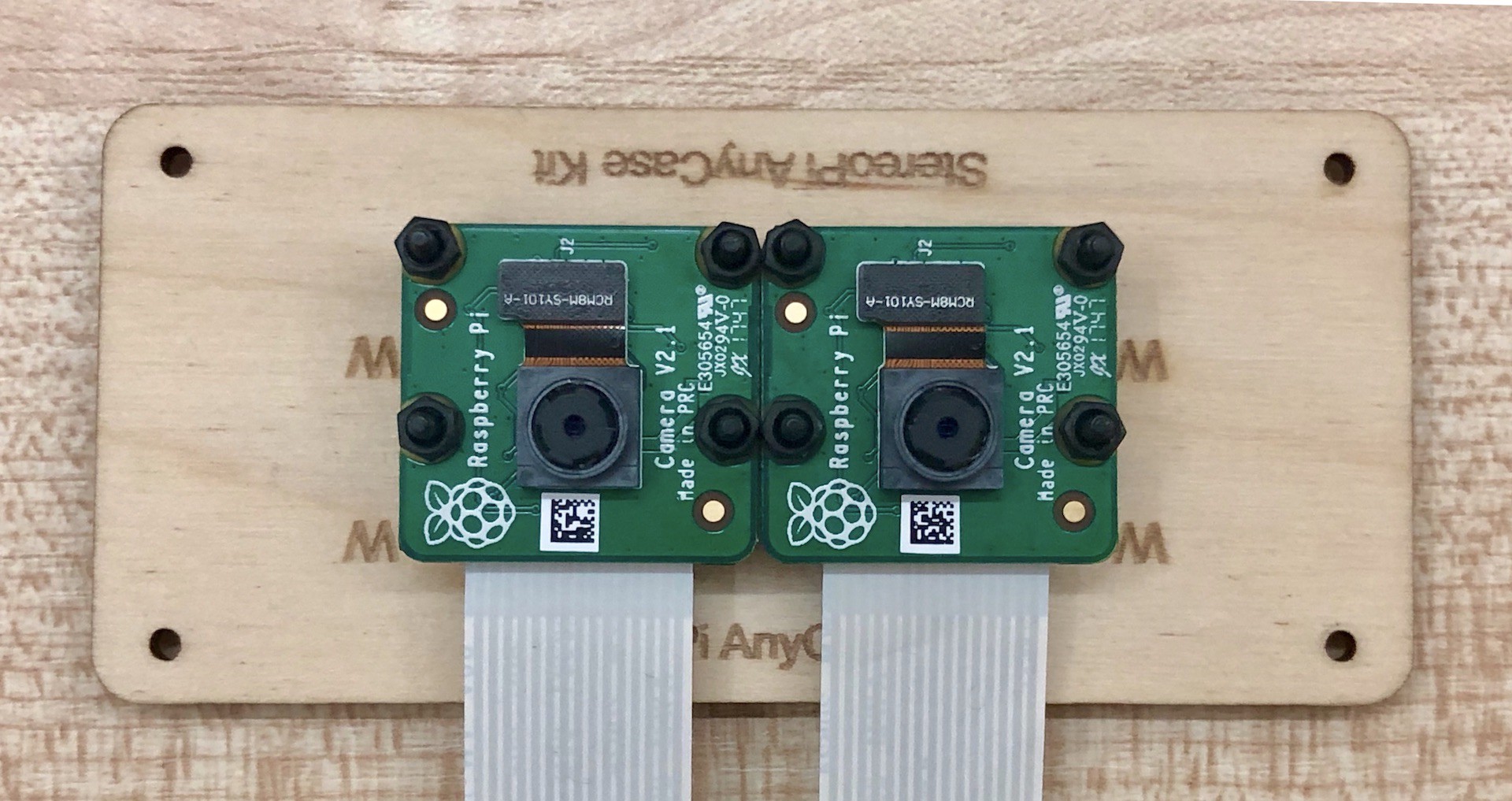
Hi 78163,<br>Interesting question.<br>The first idea is that after scaling one of your images you'll actually get the same equivalent stereobase. You can not cheat a physics here.<br>Some ideas on this:<br><br><strong class="text-strong">1.</strong> If your space is limited - for example, 50 mm width, you need to use it as effective as possible.<br>1st idea is to put a cameras as close as possible, like this:<br><img src="https://stereopi.com/sites/default/files/inline-images/v2-raspberry-pi-cameras-on-the-plate.jpg" class="postimage" alt="Image"><br><br>Camera's PCB size is 25 mm, and in this case you get <strong class="text-strong">25 mm</strong> stereobase.<br><br>This is not the most effective way.<br><br>So you can try to use a modules like this:<br><img src="https://cdn.shopify.com/s/files/1/0012/8063/9031/products/odseven_3_b0025eec-daf0-48a0-94f6-5b811db0559a_x700.jpg?v=1535769041" class="postimage" alt="Image"><br><br>In this case you'll have about <strong class="text-strong">44 mm</strong> stereo base.<br><br><strong class="text-strong">2. </strong>Tricky "animal vision" approach<br>There are also "pigeon vision" or "horse vision" approach.<br>The idea is that camera's axis are not parallel.<br><br><img src="https://stereopi.com/sites/default/files/styles/blog_1140x642_/public/2020-02/horse-vision-alan-hook_jpg_project-body.jpg?itok=2C1jO9I7" class="postimage" alt="Image"><br><br><img src="https://upload.wikimedia.org/wikipedia/commons/5/52/Fieldofview-pigeon-owl.svg" class="postimage" alt="Image"><br><br>In this case only a part of your FOV can give you 3D information (overlapped zone). Actually you'll get some additional stereo base, as your cameras optics (I mean not a pinhole, but M12) will have an angle beetween their axis, but it's just a several millimeters in comparison with the parallel mount. Also, for this camera setup all classic OpenCV calibration functions will do a crazy things, and you need to do a lot of code manually (like cutting a part of an image after undistortion for further stereoscopic rectification).<p>Statistics: Posted by <a href="https://forum.stereopi.com/memberlist.php?mode=viewprofile&amp;u=2">Realizator</a> — Fri Mar 27, 2020 11:45 am</p><hr />
]]></content>
	</entry>
		<entry>
		<author><name><![CDATA[78163]]></name></author>
		<updated>2020-03-26T16:33:19+00:00</updated>

		<published>2020-03-26T16:33:19+00:00</published>
		<id>https://forum.stereopi.com/viewtopic.php?p=1796#p1796</id>
		<link href="https://forum.stereopi.com/viewtopic.php?p=1796#p1796"/>
		<title type="html"><![CDATA[The art of stereoscopic photo • Low Profile (staggered) Stereovision?]]></title>

					<category term="The art of stereoscopic photo" scheme="https://forum.stereopi.com/viewforum.php?f=15" label="The art of stereoscopic photo"/>
		
		<content type="html" xml:base="https://forum.stereopi.com/viewtopic.php?p=1796#p1796"><![CDATA[
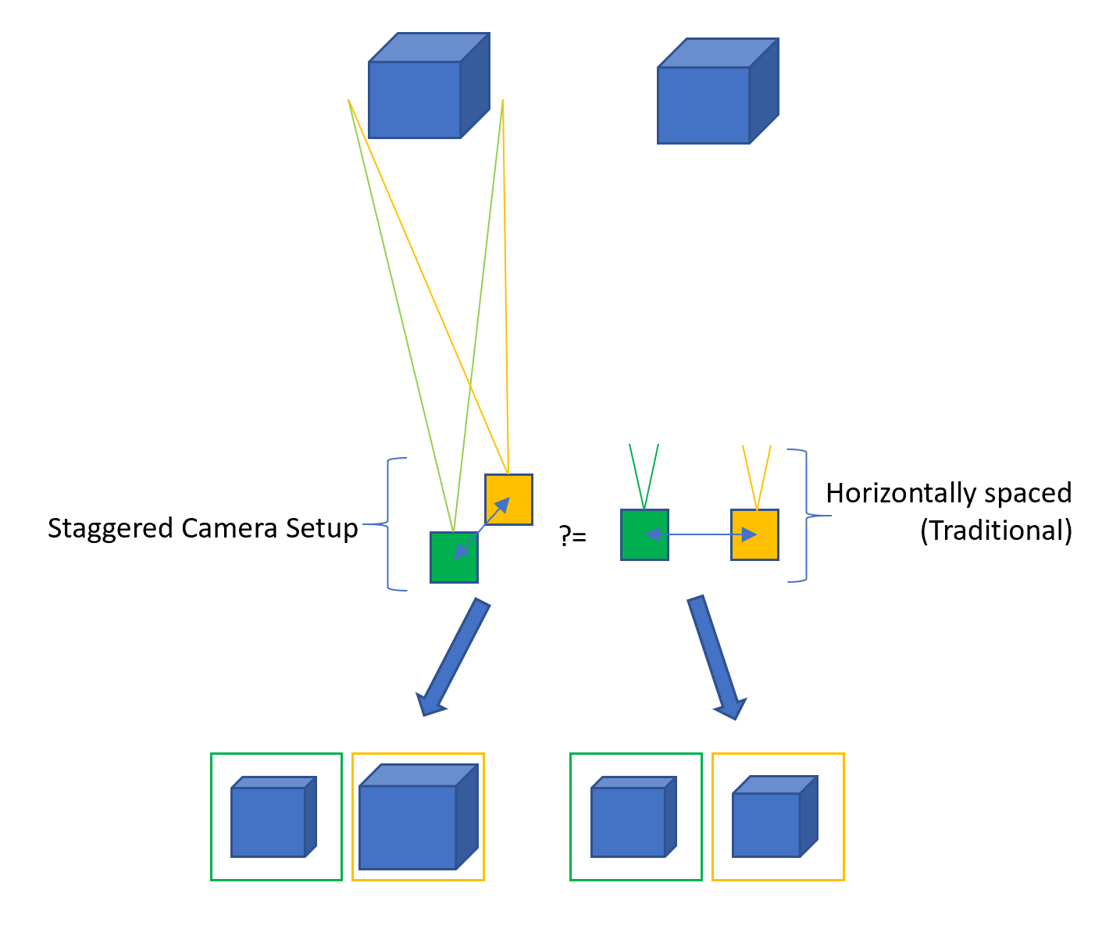
Ladies and Gents,<br><br>I know this question exists probably on some abstract openCV forum, but I haven't been able to reasonably answer it.  <br><br><strong class="text-strong">Problem</strong>:  Hardware constraints restrict me from widely mounting two cameras with sufficient IPD to generate a reliable depthmap (i.e. noise reduction).  <br><br><strong class="text-strong">Proposed solution</strong>:  I was wondering if staggering the cameras in a 2D plane versus a 1D line could 'give me' that extra camera separation and my needed IPD for depthmap reliability.  Here is a visual:<br><br><img src="https://res.cloudinary.com/dsu/image/upload/v1585239651/stereoPIconfig_wllwyr.png" class="postimage" alt="Image"><br><br>I'm trying to wrap my mind around it, but instead of lateral offset differences, the 'scale' of the objects in field would be different.  Sort of like an optical flow style problem, but instantaneous with two cameras.  Is this feasible?  Does anyone have a good research thread to deep dive on?  <br><br><strong class="text-strong">Cons</strong>:  Obviously camera FOV would be narrowed and the lead camera would obscure the trail camera FOV.  If the concept works, what other downsides would there be to this setup?<br><br>Sorry if this is common knowledge...my google-fu wasn't strong enough to find it!<br><br>v/r,<br><br>x78163<p>Statistics: Posted by <a href="https://forum.stereopi.com/memberlist.php?mode=viewprofile&amp;u=355">78163</a> — Thu Mar 26, 2020 4:33 pm</p><hr />
]]></content>
	</entry>
		<entry>
		<author><name><![CDATA[Realizator]]></name></author>
		<updated>2020-01-05T12:10:17+00:00</updated>

		<published>2020-01-05T12:10:17+00:00</published>
		<id>https://forum.stereopi.com/viewtopic.php?p=1522#p1522</id>
		<link href="https://forum.stereopi.com/viewtopic.php?p=1522#p1522"/>
		<title type="html"><![CDATA[The art of stereoscopic photo • Re: 3D macro photo. The 3rd article is here]]></title>

					<category term="The art of stereoscopic photo" scheme="https://forum.stereopi.com/viewforum.php?f=15" label="The art of stereoscopic photo"/>
		
		<content type="html" xml:base="https://forum.stereopi.com/viewtopic.php?p=1522#p1522"><![CDATA[
Yep, I meant DIY camera. <img class="smilies" src="https://forum.stereopi.com/images/smilies/icon_e_smile.gif" width="15" height="17" alt=":-)" title="Smile"><br>Actually we have some advanced <a href="http://cosmostreamer.com/" class="postlink">solution</a> for the camera control (used with the DJI family), and will try to add a StereoPi in a list of supported cameras. This way you will have a full control on all options. But we'll release it in a several months only.<p>Statistics: Posted by <a href="https://forum.stereopi.com/memberlist.php?mode=viewprofile&amp;u=2">Realizator</a> — Sun Jan 05, 2020 12:10 pm</p><hr />
]]></content>
	</entry>
		<entry>
		<author><name><![CDATA[stereomaton]]></name></author>
		<updated>2020-01-05T05:30:12+00:00</updated>

		<published>2020-01-05T05:30:12+00:00</published>
		<id>https://forum.stereopi.com/viewtopic.php?p=1520#p1520</id>
		<link href="https://forum.stereopi.com/viewtopic.php?p=1520#p1520"/>
		<title type="html"><![CDATA[The art of stereoscopic photo • Re: 3D macro photo. The 3rd article is here]]></title>

					<category term="The art of stereoscopic photo" scheme="https://forum.stereopi.com/viewforum.php?f=15" label="The art of stereoscopic photo"/>
		
		<content type="html" xml:base="https://forum.stereopi.com/viewtopic.php?p=1520#p1520"><![CDATA[
Well, biased by my vision, I imagined something different. In particular, I have interpreted the term camera as a regular photo camera with minimum control on exposure time and iso, but forgot that for non-photographers it means snapshot taker.<p>Statistics: Posted by <a href="https://forum.stereopi.com/memberlist.php?mode=viewprofile&amp;u=101">stereomaton</a> — Sun Jan 05, 2020 5:30 am</p><hr />
]]></content>
	</entry>
		<entry>
		<author><name><![CDATA[Realizator]]></name></author>
		<updated>2020-01-02T15:58:03+00:00</updated>

		<published>2020-01-02T15:58:03+00:00</published>
		<id>https://forum.stereopi.com/viewtopic.php?p=1514#p1514</id>
		<link href="https://forum.stereopi.com/viewtopic.php?p=1514#p1514"/>
		<title type="html"><![CDATA[The art of stereoscopic photo • Re: 3D macro photo. The 3rd article is here]]></title>

					<category term="The art of stereoscopic photo" scheme="https://forum.stereopi.com/viewforum.php?f=15" label="The art of stereoscopic photo"/>
		
		<content type="html" xml:base="https://forum.stereopi.com/viewtopic.php?p=1514#p1514"><![CDATA[
Stereomaton, actually we've already described simple phone-controlled stereoscopic camera in our <a href="https://medium.com/stereopi/the-art-of-stereoscopic-photo-part-2-38a2de079bcd" class="postlink">second</a> article. The key issue for me now is a comfortable case for this setup (with the battery inside the case). <img class="smilies" src="https://forum.stereopi.com/images/smilies/icon_e_smile.gif" width="15" height="17" alt=":-)" title="Smile"><br>Also I mentioned we have a lot of separate articles in a blog and some info in a Wiki, but there are no any united source of all information we have. We'll try to collect all we have in a one place (like readthedocs tool). I've played with this tool a bit, it looks great, but will take a lot of time to collect and reformat all articles.<p>Statistics: Posted by <a href="https://forum.stereopi.com/memberlist.php?mode=viewprofile&amp;u=2">Realizator</a> — Thu Jan 02, 2020 3:58 pm</p><hr />
]]></content>
	</entry>
	</feed>